Augmented Reality
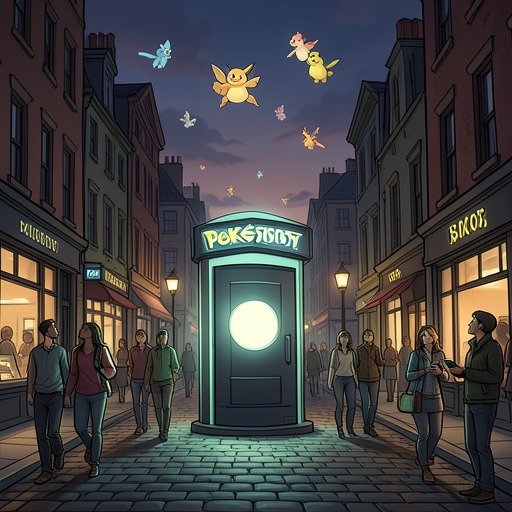
Pokemon Go: The Ultimate Beginner's Guide For Kindle Book Tips And Trick How to Become The Best Pokemon Trainer: This Kindle Book Will Answer Your Unsolved QuestionsAugmented reality is the defining spatial concept of Pokémon GO: it joins fictional Pokémon to the physical world through a smartphone’s GPS, camera, internet connection, and game interface. Rather than replacing the player’s surroundings with a wholly separate game space, it makes streets, monuments, and other real locations the stage on which catching, collecting, and competition occur.
Definition and Origins
In the guide’s account, augmented reality helps distinguish Pokémon GO from earlier Pokémon games. The franchise began with Game Freak’s video games for the original Game Boy and expanded into trading card games, animated shows and films, comic books, and toys. Those earlier forms established the recurring activities of catching, training, and battling, while Pokémon GO relocates those activities into the world inhabited by the player.
The mobile game is presented as a collaboration between Nintendo and Niantic Labs, combining GPS, augmented reality, and distinctive graphics. Its continuity with the older franchise is therefore paired with a change in medium: the player still catches Pokémon, uses items, evolves creatures, and battles at Pokémon Gyms, but the surrounding physical environment becomes part of the game’s operating field.
How the Interface Works
Augmented reality depends on the player’s actual movement. The avatar is positioned according to the player’s GPS location, and when the player walks in real life, the avatar moves in the game. The game requires an internet connection and location services; without them, its location-based operation does not work as intended. The map displays streets and the range within which the avatar can detect Pokémon, turning geographical position into an immediate gameplay condition.
The phone’s camera provides the most literal visual expression of augmented reality. During a Pokémon encounter, the camera can be activated so that the Pokémon appears in the real world as viewed through the phone. The guide also describes a camera function for saving a picture of a Pokémon on the phone, while advising players to keep the camera off when they want to conserve battery. Augmented reality is thus both an imaginative effect and a technical choice that affects device use.
Real Locations as Game Space
The concept gives ordinary places new game functions. A PokéStop is located at a real-life monument and appears on the map as an interactive landmark. As the player approaches, its shape changes; tapping it produces a photo disc that can be spun to generate items, which are then collected from the screen. The guide specifies that rewards from a particular PokéStop can be claimed only once every five minutes, so physical proximity and a programmed cooldown work together to regulate the player’s route and pace.
Pokémon Gyms extend this conversion of physical space into competitive space. They are real-world locations represented on the map by floating markers with platforms. The number of platforms indicates the Gym Level and the number of potential defending Pokémon. Players can train at a friendly Gym to increase its Prestige and Level, or challenge an opposing team’s Pokémon to reduce them. At the Gym, augmented reality does not merely place an image over a location; it attaches ownership, conflict, progression, and social meaning to that location.
Movement, Items, and Collective Play
Augmented reality connects bodily movement to the game’s resource systems. Pokémon eggs are placed in an Egg Incubator and require the player to walk in real life while keeping the game open. The guide identifies 2-kilometer, 5-kilometer, and 10-kilometer eggs, with the longer-distance eggs described as rarer and generally associated with greater rewards and better Pokémon. Walking therefore becomes both a physical activity and a measurable path toward experience, Stardust, and a new Pokémon.
Items also organize the player’s relationship with shared locations. Incense attracts Pokémon around the player for 30 minutes, while a Lure Module attracts Pokémon around a PokéStop for 30 minutes and may benefit other people nearby as well. These mechanics make the augmented environment partly personal and partly communal: a player can activate an effect at a location, but that effect can draw other players into the same physical and virtual space.
The guide presents this outdoor structure as more than a technical novelty. Players are encouraged to explore the real world with friends, laugh while checking in at historical monuments represented as PokéStops, and make connections with other would-be Pokémon Trainers in their neighborhoods. Augmented reality consequently changes not only what the player sees through the phone, but also how familiar places are visited and how encounters with other people become possible.
Expansion Beyond the Phone
The concept also anticipates a wider device ecosystem. The Pokémon Go Plus is described as a wearable peripheral intended to let players visit PokéStops and catch Pokémon without looking at their phones. The guide presents it as a possible future addition that could give gameplay greater depth, suggesting that augmented reality can extend beyond the camera screen into a form of play mediated by a dedicated wearable device.
This expansion preserves the same basic relationship among player, location, and game rules while reducing dependence on direct visual attention to the phone. At the same time, the guide notes practical costs and conditions surrounding the mobile experience: the screen generally needs to remain on while the application runs, and the game requires a stable online connection and an active GPS signal. Augmented reality is therefore enabled by a network of hardware, connectivity, location data, and player movement rather than by visual overlay alone.
Significance
Augmented reality is significant because it turns the Pokémon franchise’s established ideals of collecting and battling into a location-based practice. The player’s body supplies movement, the phone supplies the interface and camera, GPS supplies position, real monuments supply landmarks, and Pokémon GO’s rules convert those elements into encounters, rewards, and competition.
The result is a hybrid space in which the virtual and physical are continually coordinated. A street becomes a route, a monument becomes a PokéStop, a location becomes a Gym, and walking becomes progress toward hatching a Pokémon egg. The guide’s larger promise of helping players master the game rests on this transformation: understanding Pokémon GO means learning not only the franchise’s creatures and objectives, but also how real-world movement and places have been reorganized as playable systems.